Showing posts with label Emotion. Show all posts
Showing posts with label Emotion. Show all posts
Thursday, February 14, 2013
Perception and Art
Eric Kandel (born November 7, 1929) is an American neuropsychiatrist. He specialises in research into the nature of memory, for which he received the Nobel Prize for Physiology or Medicine in 2000. Here he talks about the links between art, perception, emotion and biology:

Monday, February 11, 2013
Saturday, July 7, 2012
Thursday, June 21, 2012
Autism, Empathy and Ethics
I posted a video recently in an attempt to show the link between ethics and empathy. If you define ethics along the lines of the practical application of morals in society (as we have in the class), then it follows that without some form of empathy (to understand the effect of your actions on others) you are unable to employ a true ethical code.
A common (mis)conception is that people with autism lack the ability to empathise. I'll admit to being guilty of thinking like this in the past. If this is true then it could be argued that autistic people lack the ability to be ethical. In her blog existence is wonderful, Anne Corwin (who has herself been diagnosed with Asperger Syndrome) shows this is a fallacy, and that while autistic people perhaps have a different take on empathy, they cannot be catagorised as non-ethical. She makes the point that the act of labelling and categorising people is, in itself, very harmful.
This makes me think that coming up with a useful and usable definition of ethics is much more difficult than you might think. Incidentally, if you are interested in seeing the autism-spectrum quotient test that she refers to in the article, I have found a copy of it here.
Autism and Empathy
Sunday, June 17, 2012
Friday, April 20, 2012
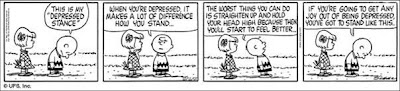
Laughter Therapy and the James-Lange Theory
William James (1842-1910) and Carl Lange (1834-1900) were academics who studied the relationship between emotion and physical changes in the body. In about 1885, they independently proposed that emotion is dependent on two things: physical changes in our bodies and our interpretation of them. They felt that physical changes occur first and subsequently their interpretation. Together, they create the emotion. James is quoted as saying "the perception of bodily changes, as they occur, is the emotion ...we feel sad because we cry, angry because we strike, afraid because we tremble, and neither we cry, strike, nor tremble because we are sorry, angry, or fearful, as the case may be." (W. James. 1884. "What Is an Emotion?" Mind. 9, 34, 188-205).
The James-Lange Theory has fallen out of favour with psychologists in recent years, but there is some evidence that emotion in some aspects occurs as part of a bodily feedback mechanism in the way the James-Lange theory suggests. Proponents of this idea include so-called 'laughter therapists'. Among these are practitioners of a form of yoga known as Hasyayoga, who believe that fake laughter can trigger intense joy and therefore have beneficial physiological and psychological effects. When I watch the video below, I'm not sure if I'm laughing with him or at him - but in terms of the theory, I don't think that matters.
The James-Lange Theory has fallen out of favour with psychologists in recent years, but there is some evidence that emotion in some aspects occurs as part of a bodily feedback mechanism in the way the James-Lange theory suggests. Proponents of this idea include so-called 'laughter therapists'. Among these are practitioners of a form of yoga known as Hasyayoga, who believe that fake laughter can trigger intense joy and therefore have beneficial physiological and psychological effects. When I watch the video below, I'm not sure if I'm laughing with him or at him - but in terms of the theory, I don't think that matters.
Tuesday, December 15, 2009
Reason and Emotion
In 1943 Walt Disney studios produced an animated film entitled "Reason and Emotion". It was subsequently nominated for an Oscar. At its heart it is, of course, a piece of war propaganda. This is particularly obvious in its depiction of Hitler and his manipulation of people's emotions to gain and maintain power. I thought that its treatment of the two subjects is more than a little simplistic, particularly its depiction of emotion as a primitive out of control caveman. It suggests that emotion is something base that needs to be contolled in order to make rational decisions. However, the ending does show reason and emotion coming together as co-pilots in order to bomb the enemy. What do you think of it?
Wednesday, May 6, 2009
Emotion and Language
 In 2007 the BBC's flagship current affairs series, Panorama, tried to produce a programme discrediting the Church of Scientolology. They found themselves among the first victims of "video ambushing", in which the people being investigated turn the tables on the journalists. The BBC interviewer, John Sweeney remained remarkably calm as he was followed around by a Scientologist spokesman, Tommy Davis, for six days. However, he eventually lost it in an embarassing outburst. Sweeney was later disciplined by the BBC, and made a public apology. The Church of Scientology produced their own documentary, refuting Sweeney's claim and making him look extremely foolish. The moral is... try to be in control of your emotions before you open your mouth (admittedly sometimes easier said than done).
Here is a link to the whole programme if you are interested in watching it:
Panorama - Scientology and Me
Monday, May 4, 2009
Emotion and Reason
When somebody feels very emotional about a particular subject, reason sometimes goes out of the window. BBC journalist Louis Theroux recently visited members of the Westborough Baptist Church in Kansas. They have been called the "most hated family in America" after they started picketing the funerals of American servicemen killed in Iraq, in a protest against the prevalence of homosexuality in the USA. He tried (in his own way) to reason with their leaders (Fred Phelps and Shirley Phelps-Roper) but came away as lost as when he started.
In this second clip Shirley Phelps-Roper, daughter of Pastor Fred Phelps appears on Fox News in order to defend the church - but can you follow her reasoning?
Eugène Ney Terre'Blanche (born January 31, 1941) is a Boer-Afrikaner who founded the Afrikaner Weerstandsbeweging during the apartheid era in South Africa. Terre'Blanche remains leader of the recently reactivated AWB and continued to push for an Afrikaner state within South Africa (until his death in 2010). In this clip he explains his reasoning to Louis (and obviously frightens the life out of him).
Eugène Ney Terre'Blanche (born January 31, 1941) is a Boer-Afrikaner who founded the Afrikaner Weerstandsbeweging during the apartheid era in South Africa. Terre'Blanche remains leader of the recently reactivated AWB and continued to push for an Afrikaner state within South Africa (until his death in 2010). In this clip he explains his reasoning to Louis (and obviously frightens the life out of him).
Saturday, March 21, 2009

Sunday, March 8, 2009
Stoicism
 This is a way of life originally proposed by the Greek philosopher Zeno (333 BC-264 BC) which advocates:
- That in order to find true happiness, we must learn to be indifferent to external influences.
- If we can learn this indifference to external events, no matter how horrible (like slavery, torture, rape, imprisonment, etc.), then others will have no power over us in any significant way.
- That virtue resides in the will; therefore, the exercise of free will alone determines what is good and what is evil.
- A good life comes from being able to free oneself from desires and passions (stoicism shares this value with Hinduism and Buddhism).
- Your essential character cannot be destroyed by external events in your life.
- Virtue consists in a will that is in agreement with the happenings of nature in which all is part of a divine design that is unalterable.
- That all behavior is ultimately determined by natural laws, but without free will no one can be held responsible for their own actions.
- That responsibility for becoming good or bad resides with the individual and not with society at large.

Saturday, March 7, 2009
Emotional response


Thursday, March 5, 2009
Rationalisation
 A famished fox saw some clusters of grapes hanging from a vine, She resorted to all of her tricks to get at them, but wearied herself in vain, for she could not reach them. At last she turned away, hiding her disappointment and saying “ Those grapes are sour and not as sweet as I thought”
from Aesops fables
Rationalisation is the justification of bad reasoning by somebody in an emotional state
Monday, March 2, 2009
Primary Emotions
Japanese scientists have finally cracked the problem of giving a robot primary emotions (well... not quite). But which is which? (fear, surprise, anger, disgust, happiness, sadness):

Sunday, February 22, 2009
The James-Lange Theory
The James-Lange Theory proposes that emotions occur as a result of physiological reactions to events. According to the theory, you see an external stimulus that leads to a physiological reaction. Your emotional reaction is dependent upon how you interpret those physical reactions.